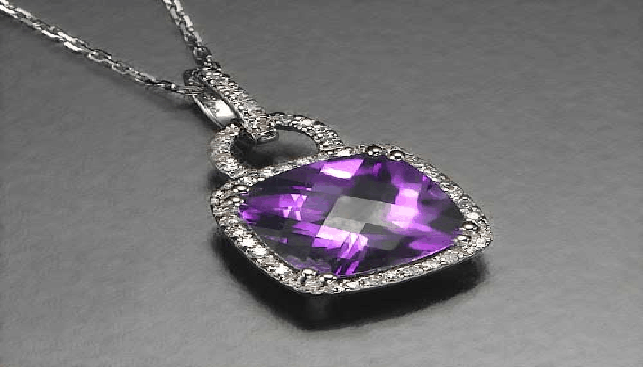
Amethyst, a purple gemstone, is February’s birthstone. The theory of crystals attributes amethysts with many healing powers, including balancing the human energy centers and increasing spiritual enlightenment.
Origin of the Name Amethyst
Amethyst is a violet-colored quartz whose name is derived from the Greek terms “A” (“not”) and “Methustos” (“intoxicated”), which alludes to the ancient Greeks’ belief that the stone protected its owner from intoxication. Greco-Romans would drink out of amethyst chalices, believing it would prevent them from becoming inebriated. According to Pliny, the Greek name was derived from the purplish color of the stone, which resembled the color of wine.
The Hebrew name of the stone – “Achlama” – is reminiscent of the root word “halom,” meaning “dream,” as the stone was believed to induce visions or dreams; and its Arabic name – “al-Halma” – is derived from a similar belief.
Amethyst in Judaism
The amethyst is believed to be the ninth stone placed on the ceremonial breastplate (“hoshen”) worn by the high priest of the ancient Israelites, in representation of the Tribe of Gad. It is thus fitting that the latter, a warring tribe, was affiliated with the amethyst, which was believed to inspire courage in a warrior in battle.
The Midrash describes the amethyst as a stone that can help cure eye ailments, as well as a “dark stone with white striations,” and warns that anyone carrying it may suffer from bad dreams or become grief-stricken.
Attributes and Healing Properties of Amethyst
It is believed that the amethyst balances the body’s energy centers and enhances spiritual understanding. According to Hindu beliefs, the amethyst can help open the third eye, which represents the soul.
In ancient times it was also believed that amethysts could help to wean a person from alcohol or sweets. It was also believed to enhance the intelligence of the wearer.
Amethysts were also believed to be helpful against insomnia, headaches and toothaches. The amethyst was dipped in hot water and then rubbed gently against the affected part of the body or the neck. Some wore the gemstone as protection against contagious diseases.
Historical Background of Amethyst
In ancient Egypt, soldiers would carry amethysts, believing the stone would protect them from being killed on the battlefield.
Roman Catholic Church cardinals wore – and still wear – amethysts as a sign of divine purity and spiritual understanding. Purple is also the signature color of the ceremonial cardinal robes, which also include an amethyst ring.
The amethyst is affiliated with the royal English court. It was first worn by Edward the Confessor in the 11th century; and Queen Charlotte, wife of King George III, was said to favor a priceless amethyst necklace.
The empress of Russia Catherine the Great also wore an amethyst necklace crafted of gems harvested from the Ural Mountains. It was described as “gleaming by night like red fire.”
Modern tradition names amethyst Saint Valentine’s favorite gem. He reportedly wore an amethyst ring engraved with the image of Cupid.
Myth regarding Amethyst
According to Greek mythology, when Dionysus, god of wine, was abandoned by Diana, the goddess of the hunt, he vowed to take vengeance upon the first person he saw. The first human to cross his path was a beautiful maiden named Amethyst, who fell prey to his rage and was set upon by animals. Rushing to the girl’s aid, the goddess Diana turned her to stone. Furious, Dionysus drenched the stone in wine, staining it purple.
Mining of Amethyst
In ancient times, amethysts were mined in India and Saudi Arabia. Today, they are mined primarily in Brazil, Uruguay, the United States, Madagascar, India and Russia.
Famous People Born in February
Charles Dickens, Abraham Lincoln, George Washington, Frederic Chopin, Ehud Barak, Yoko Ono
| Chemical formula: | SiO2 |
| Group: | Quartz |
| Color: | Various shades of purple |
| Mohs scale hardness: | 7 |
| Specific gravity: | 2.63-2.65 |
| Crystal system: | Trigonal |
| Zodiac: | Pisces |
| Planet: | Pluto |
| Christian apostle: | Saint Matthew |
| Kabala-affiliated angel: | Adnachiel |
| Hindu chakra: | Ajna – the sixth primary chakra |
By: Iris Hortman
FAQ Amethyst: February’s Birthstone
What is the origin and meaning behind the name “amethyst”?
The name amethyst is derived from the Greek terms “A” (“not”) and “Methustos” (“intoxicated”), reflecting the ancient Greeks’ belief that the stone protected its owner from intoxication. Greco-Romans would drink from amethyst chalices believing it would prevent them from becoming inebriated. According to Pliny, the Greek name also related to the stone’s purplish color resembling wine. The Hebrew name “Achlama” comes from the root word “halom” meaning “dream,” as the stone was believed to induce visions, while the Arabic name “al-Halma” derives from a similar belief about dream-inducing properties.
What role does amethyst play in religious and royal traditions?
In Jewish tradition, amethyst is believed to be the ninth stone on the ceremonial breastplate (“hoshen”) worn by the high priest of ancient Israelites, representing the Tribe of Gad and inspiring courage in warriors. Roman Catholic Church cardinals have worn amethysts for centuries as symbols of divine purity and spiritual understanding, with purple being their signature ceremonial color. The stone has strong royal connections, first worn by Edward the Confessor in the 11th century, favored by Queen Charlotte (wife of King George III), and worn by Catherine the Great of Russia in a necklace crafted from Ural Mountain gems described as “gleaming by night like red fire.”
What healing and spiritual properties are attributed to amethyst?
Amethyst is believed to balance the body’s energy centers and enhance spiritual understanding, with Hindu beliefs suggesting it can help open the third eye representing the soul. Historically, the stone was thought to help wean people from alcohol or sweets, enhance intelligence, and protect against insomnia, headaches, and toothaches. Ancient Egyptians believed soldiers carrying amethysts would be protected from death in battle, while some used the stone as protection against contagious diseases. Modern crystal theory attributes amethysts with powers to increase spiritual enlightenment and balance human energy centers.
Where is amethyst mined and what are its physical characteristics?
Amethyst, a violet-colored quartz with the chemical formula SiO2, was historically mined in India and Saudi Arabia but is now primarily extracted from Brazil, Uruguay, the United States, Madagascar, India, and Russia. The stone displays various shades of purple, has a Mohs scale hardness of 7, and a specific gravity of 2.63-2.65 with a trigonal crystal system. Astrologically, it’s associated with the zodiac sign Pisces, the planet Pluto, and in Hindu tradition with the Ajna chakra (the sixth primary chakra), while also being connected to Saint Matthew in Christian tradition.