
What Are Lab-Grown Diamonds?
Alongside natural diamonds, lab-grown diamonds – also called synthetic diamonds – have entered the gemstone market. These don’t originate in nature but are created through an artificial, man-made process.
In laboratory conditions, scientists replicate the environment in which natural diamonds form. These conditions involve extremely high pressure and temperature, so instead of waiting millions of years, diamonds can now be produced quickly and in a controlled manner.
What Do Lab-Grown Diamonds Cost?
Today’s technology makes it possible to produce synthetic diamonds that look identical to natural ones, while their cost is lower than that of natural diamonds.
Are Lab-Grown and Natural Diamonds the Same Thing?
A stone that comes from the earth and a stone created in a lab are two very different things. A natural diamond is a gemstone formed deep within the earth over millions of years – no two stones are alike, which is what gives them their great value. Lab-grown diamonds, by contrast, are produced using technological means in just a few days, and in the future will be manufactured in large quantities, which is why their value may decline over the years.
Throughout history, natural diamonds have not only held their value – their prices have generally risen (with some fluctuation), giving rise to a secondary market that allows people who purchased a real diamond to resell it and receive cash in return. I have yet to hear of a jewelry store willing to buy back a lab-grown diamond after the customer walks out the door.
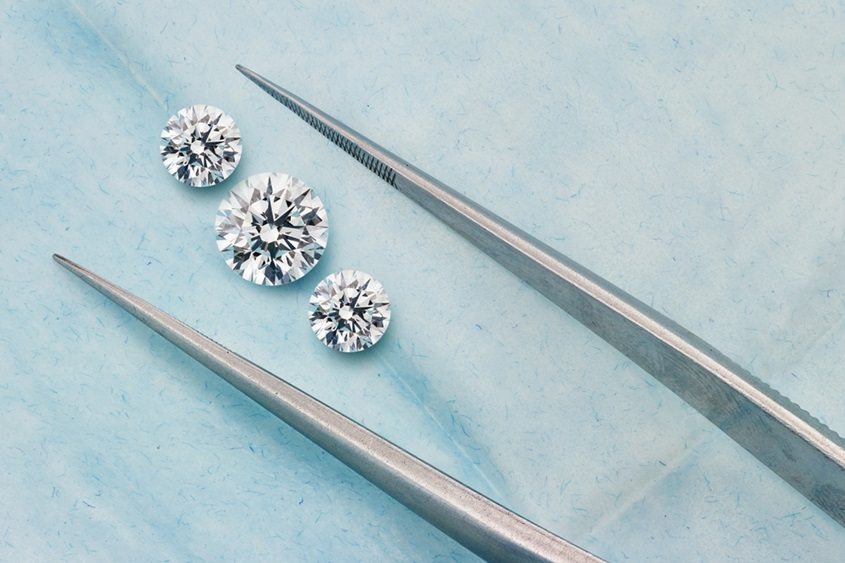
Are Lab-Grown Diamonds Really Tens of Percent Cheaper, as Advertised Online?
Companies that manufacture and sell lab-grown diamonds are misleading the public on the subject of pricing. To properly compare prices, you need to compare two completely identical products – and that’s exactly what I did when I visited the website MiaDonna in August 2017. I compared their lab-grown diamonds to natural diamonds listed on the well-known site Blue Nile, which sells GIA-certified natural diamonds.
Here are the results from August 2017:
· MiaDonna (lab-grown diamonds) listed a round stone, 1.01 CT, E VS1, for $5,200
· Blue Nile (natural diamonds) listed a comparable stone, 1.02 CT, E VS1, for $7,400
So as we can see, the lab-grown diamond was only 14% cheaper at that time – not the dramatic savings being advertised.
Back in August 2017, I published an article on this website, in which I analyzed what was then a new trend: lab-grown diamonds. While everyone was talking about a “market revolution” and promising they’d be only 30% cheaper than a natural diamond, I conducted an independent price comparison and came out with an unambiguous forecast: the value of lab-grown diamonds was going to collapse over time.
I predicted that a technology capable of producing stones in commercial quantities within just a few days could never maintain value or generate a resale market the way a natural diamond can. And here we are today… Reality exceeded all imagination.
The value of lab-grown diamonds has plummeted by more than 96%. Here’s a reminder of what I wrote back then: I explained that a lab-grown diamond is an industrial product born from an artificial replication of pressure and heat, while a real diamond is a limited, unique natural resource.
The surprising price comparison of 2017: I demonstrated how on sites like MiaDonna, lab-grown diamonds were being sold at prices nearly identical to comparable natural diamonds on Blue Nile.
How to protect yourself: Even then, I urged the public not to be tempted, and not to purchase a large stone without an international gemological certificate (such as GIA) confirming it is a natural diamond.

My bottom line from back then remains true today: if you’re looking for technological novelty – lab-grown is fine. But if you’re looking for full value for your money, value that is preserved for generations, and a ring that is truly one-of-a-kind – there is no substitute for a natural diamond.
These days, natural diamonds are being listed on international trading platforms, for example, round stones (the most traded cut, commonly set in engagement rings) weighing 1.01 carats, color E, clarity VS1, with Excellent cut, polish, and symmetry grades, are priced between $3,500 and $4,200. Meanwhile, round lab-grown diamonds of the same weight, color, and clarity are listed on trading platforms for just $150 to $180 – exactly the outcome I predicted years ago: a value decline of over 95%.
These are staggering numbers, and they prove beyond any doubt that my 2017 forecast was remarkably accurate. Anyone who bought a lab-grown diamond back then thinking they were “saving money and buying an asset” is left today with a product that has lost almost all of its value.
My bottom line from 2017 remains true, and today it is carved in stone: A natural diamond is a one-of-a-kind creation of nature that holds its value. A lab-grown diamond is an assembly-line industrial product. If you want full value for your money and value that lasts for generations – don’t be tempted by shortcuts. There is no substitute for the real thing.
A natural diamond is a breathtaking creation of nature. Every natural diamond will always be unique and one-of-a-kind – which is why it is cherished and valued by women who wear gold jewelry set with natural diamonds.
Lab-grown stones are a testament to technological progress, but they do not hold financial value over time.
So if you’re planning to purchase a diamond and want full value for your money, natural diamonds are a far better choice than man-made ones.
Courtesy of Moti Israeli, Ramat Gan Diamond Exchange, Israel